The Importance of Options: Honors Graduate Christopher Brinkley-Pridgen


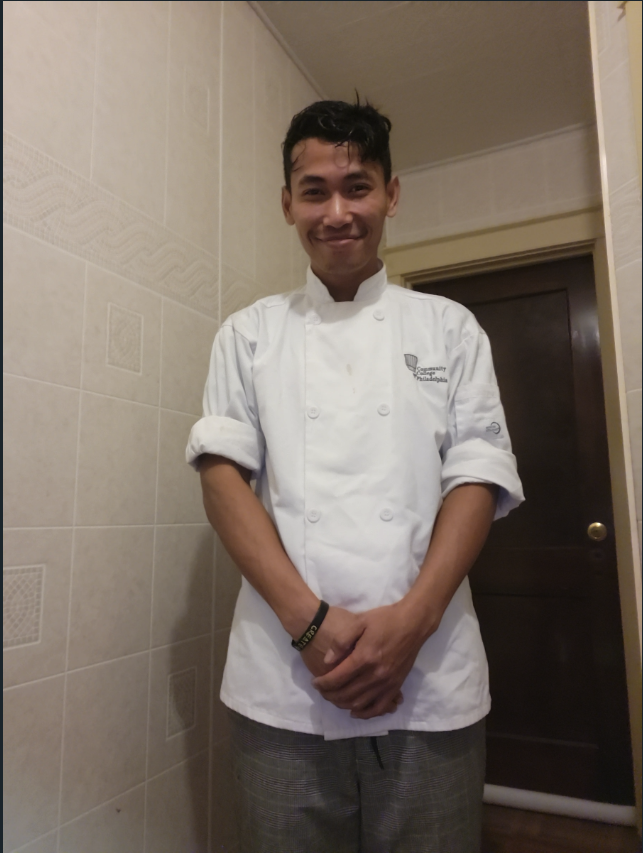
Earning a degree in Liberal Arts – Honors this year marked a milestone in Christopher Brinkley-Pridgen’s educational journey, which is far from over. His experience and preparation at the College has led him to Cheyney University, and admittance to Columbia University. 

“I was always into learning. I always had good grades. I knew I would be successful,” he said. While his path hasn’t been exactly what he envisioned, his academic experiences have provided a strong foundation for his future.

Christopher graduated as the salutatorian of his high school, and earned certifications from the District 1119C Training Fund to pursue a career in behavioral health or human services. In summer 2020, he faced the loss of his grandmother, his biggest emotional supporter. 

“I promised her I would get a degree; I needed a degree. I didn’t know what to do. A teacher in the Training Fund suggested I go to CCP and apply for financial aid,” said Christopher.

With only a few credits transferring, and starting in English 098 in preparation for college-level English, he enrolled at CCP in September 2020. Christopher excelled, earning a 3.5 GPA, and received academic honors. Through an email congratulating him on his accomplishment, he learned about the Honors program and switched his major from Behavioral Health/Human Services. 

“I wanted to challenge myself. I just kept striving,” said Christopher. 

The next semester, he earned a 4.0 GPA. 

Unfortunately, before Christopher graduated, he suffered the loss of his father.

“I wanted to give up multiple times. I didn’t give up, and other people believed in me,” he said.

Christopher earned a 4.0 GPA in his last semester and finished with a 3.73 cumulative GPA, graduating in the top 3 percent of his class. 

Christopher got involved with the College’s Center for Male Engagement, where he helped other students with their academics and thought about the next steps after the College. “CME helped me so much,” he said. He was also involved with the Student Government Association and was a member of Phi Theta Kappa, the international two-year honor society. 

While deciding where to continue his education, Christopher took a chance and applied to Columbia, and was accepted. He deferred his acceptance since he received the Keystone Scholarship from Cheyney University, where he is taking classes to defray the cost of Columbia. If the Ivy League’s aid package isn’t as good as he hopes, Christopher can stay at Cheyney and continue in the American Political Studies program, where his objective is to earn a 4.0 GPA and become valedictorian. If he stays at Cheyney, he will need a 3.0 GPA to have his master’s degree at a partner institution paid for, and he is interested in pursuing his doctorate. Christopher plans on pursuing psychology or sociology programs so he can help others and continue to demonstrate the power of education. Also, since he is considered a rising junior at Cheyney University, he will be able to graduate a year early to further his academic career. 

“Always have different alternatives. Never give up on your dreams. Focus on it, and go after it. It’s understandable to switch majors. I hope my message can inspire other people,” he said.

As a proud CCP grad, he credits his program for the growth in his potential.

“CCP is a really good institution. The Honors curriculum taught me so much. I can do anything. I am so prepared to tackle anything that comes my way,” said Christopher.


Summary
Earning a degree in Liberal Arts – Honors this year marked a milestone in Christopher Brinkley-Pridgen’s edu…
Publish Date
Sep 7, 2022
Original nid
6051

Meet The Man Who Inspired the Pulitzer-Prize Winning Podcast “Suave”


Luis “Suave” Gonzalez is the first support coach for the College’s I Am More Reentry Engagement program. Tasked with supporting students who are navigating life after being involved in the criminal justice system, Luis sees this work as his life’s calling. However, Luis is more than his work; he’s an artist, storyteller, Tedx speaker, and host of his own podcast titled “Death By Incarceration.”  

In May, it was announced that “Suave” – a podcast detailing Luis’ life during and after serving more than 30 years in prison – won a Pulitzer Prize for audio recording. We sat down with Luis to discuss this major win, what brought him to the College, and how he uses his experiences to support others with backgrounds similar to his own.   

Q: You recently attended a ceremony to officially celebrate “Suave” winning a Pulitzer Prize for audio recording. How does it feel to have your story recognized with one of highest honors for journalism and the arts? 

A: Being recognized with the highest honor in journalism and arts means that criminal and juvenile justice can no longer be denied. We, those affected by our justice system, now have a seat in front of the table instead of being a footnote on the menu. Attending the ceremony for the Pulitzer Prize was great – another opportunity to share the grounding breaking work CCP and the I Am More program are doing to ensure returning citizens have a fair chance at restarting their life after incarceration. 

Q: Maria Hinojosa, her company Futuro Media, and the Public Radio Exchange (PRX) helped bring “Suave” the podcast to life. In fact, you first met Maria more than 25 years ago. What impact has she had on your life and how has your relationship transformed over the years? 

A: Maria Hinojosa in my mentor. She’s the first person that ever told me I AM MORE THAN MY WORST MISTAKE. She also the first person that gave me a book to read. Our friendship started as a source-reporter kind, but over the years it has evolved into a family kind of relationship.  

Yes, PRX and Futuro helped bring the “Suave” podcast to life, but Maria and I are the force behind the podcast: We had a vision and we studied what was out there. The “Suave” podcast has been in the works for almost 20 years. A lot of what you hear in the podcast was recorded years ago. And for the record, I am a producer/writer for Futuro Media, and I own the rights to the “Suave” podcast. 

Q: You now have your own podcast titled “Death By Incarceration.” What does the podcast cover and what inspired it? 

A: Yes, I am the founder and creator of DBI Media, which produces the podcast “Death By Incarceration.” We cover the entire criminal justice system. Our guests range from district attorneys, lieutenant governors, politicians, victims' advocates, formerly incarcerated individuals, and citizens who are still incarcerated. What inspired me to create this podcast was the lack of media attention in low-income communities. I wanted to create a platform to give the community a chance to express themselves without being censored by traditional media. 

Q: How have your experiences helped inform the work you do as a success coach for the College’s I Am More program? 

A: I got all my education while I was in prison. It prepared me for a better life. Once I understood that education was the only thing that no one can take away from me, I fell in love with it. I began seeing it as a way to save Black and brown men from ending up in prison.  

Q: What was it about the I Am More program that made you want to apply for the position? 

A:  What attracted me to the I Am More program was the love and respect the coaches and the leadership offered to the men. I was extremely impressed with Mr. Perkins’ and Dr. Generals’ leadership. In 2018, I spoke to the reentry program, which became the I Am More program and I saw a few people I knew. I could not believe that such a program was available. Last September I was invited to speak again for Hispanic Heritage Month, and I learned that a position was open. 

At first, I did not want to apply because I was not sure if CCP would hire a formerly incarcerated person. Plus, I had a few other offers from a few other schools. But once CCP made the offer, I passed on the other schools. The I Am More program is the only available pathway to success for returning citizens right now in Philadelphia. We provide the services we say we have. We invest in the lives of those who have been affected by our justice system. That’s what made me come to CCP. 

Q: What role do you think institutions of higher education have in creating opportunities for individuals formerly involved in the criminal justice system? 

A:  Institutions of higher education have a duty to offer educational opportunities to formerly incarcerated individuals because in doing so, they will be contributing to the safety of our community. We all know that when a formerly or incarcerated person is given an education, their chance of reoffending reduces.  

Q: What advice would you give 17-year-old Luis or another teenager who is struggling to find their place in the world? 

A:  Never give up hope! Listen to your parents, surround yourself with positive people, and think 20 times before you act with your emotions. 

Q: You also recently made your Off-Broadway debut in Quiara Alegría Hudes’ “Emancipated Stories” at the Signature Theater in New York City. Are there any other exciting projects you’re involved in that we should know about?  

A: I have known Quiara Alegría Hudes for a long time. “Emancipated Stories” is a project that I helped with while I was still in prison. So, when I got the call to be part of it, I said yes. It puts formerly incarcerated people in a different light. It changes the narrative of what we are supposed to do after incarceration. 

New projects coming in the next few months that I’m involved with include: “Suave Session 2” which is coming to a city near you; “Cell Block Dean List” which is a new podcast about prison education; and a partnership with West Chester University produced by myself/DBI Media, Glass Box Media, and Crawlspace. I’m also doing some work with Roc Nation for Made In America. Lastly, I’m currently shooting a documentary with Maria and Futuro Media that is produced by Lisa Ling’s production company. 

Summary
Luis “Suave” Gonzalez is the first support coach for the College’s I Am More Reentry Engagement progra…
Publish Date
Aug 10, 2022
Original nid
6028

Meet Dr. Alycia A. Marshall: The College’s New Vice President of Academic and Student Success


Meet Dr. Alycia A. Marshall, the College’s new vice president of Academic and Student Success. Dr. Marshall joins the College from Anne Arundel Community College (AACC) in Arnold, MD where she worked for the past 22 years. 

While her most recent role at AACC was associate vice president for Learning and Academic Affairs, she has served in a number of positions, including interim vice president for Learning and chair of the Mathematics Department.

While at AACC, Dr. Marshall was responsible for transforming the Math Department’s developmental math course sequences which resulted in higher success rates. She also served as the principal investigator for the Engineering Scholars Program, a National Science Foundation grant program that provided scholarships and academic support to high achieving students with financial need who were pursuing careers in engineering and engineering technologies. With a focus on women and people of color, under Dr. Marshall’s leadership, 120 students were awarded $479,480 in scholarships.

We sat down with Dr. Marshall to learn more about why she chose CCP and what she hopes to accomplish in her new role:

Q: What made you interested in the vice president of Academic and Student Success position at CCP? What do you hope to accomplish in this position? 

A: I was drawn to CCP because of the diversity of your student population, its status as a minority-serving institution, the College’s steadfast and ongoing commitment to diversity, equity, inclusion and antiracism and the extreme passion that CCP faculty and staff have demonstrated in support of student success and completion. These values align extremely well with my own lived experience as a student of color and my personal commitment to this work. It is my hope to continue to build upon the great programs and initiatives that are already yielding increased student success, while collaborating with my new colleagues to further improve our outcomes for all students. 

Q: What sparked your interest in pursuing a Mathematics degree and later teaching?

A:  I was fortunate to have been selected to participate in a competitive Science and Technology magnet program in high school. The program exposed me early on to STEM and helped me to develop foundational knowledge which I leveraged during my undergraduate experience at University of Maryland, Baltimore County (UMBC). 

I was motivated by UMBC’s focus on developing and supporting high-achieving African American students along the pathway to obtaining doctorate degrees in STEM fields. I took classes with other students who looked like me and were successful in fields where they had been historically underrepresented.  This motivated me to study harder, to match their success, and to eventually be the face of color and support for my students who had similar goals.

Q: For more than 20 years, you’ve worked at a community college. What makes community colleges special to you?  

A: Having grown up as the daughter of a Panamanian immigrant who came from humble means, I grew to intimately understand and resonate with the mission of community colleges; particularly the focus on providing access to education and the “American dream” for students who may not otherwise experience it.  My work over the years has focused on increasing participation, success and completion for underrepresented students, low income students and students of color, while striving to meet the educational and economic needs of the community. I believe community colleges are special places where those who are passionate about equity and student success come together to transform lives.

Q: You were instrumental in transforming the developmental math curriculum at AACC. Can you describe what you were able to accomplish? How did you navigate this process? Did you face any challenges? 

A: I was honored to be part of the Maryland Mathematics Reform Initiative steering committee which brought together state and national thought leaders to address the challenges Maryland students were experiencing trying to complete their credit mathematics requirements. We worked collaboratively to change the state requirements (Code of Maryland Regulations) for general education in mathematics which laid the groundwork for developing alternative mathematics pathways for students more closely aligned with their programs of study. This allowed me to work alongside my colleagues in the mathematics department at AACC to develop a statistics pathway, an alternative to the traditional college algebra/calculus pathway, which led to improved student success and completion outcomes at AACC and statewide.  

These gains were particularly evidenced among students of color who had been historically overrepresented in long, developmental math course sequences with limited success. Initial challenges included working with my colleagues in mathematics across the state, who in some cases, were not in support of creating another pathway and only in favor of keeping the traditional algebra/calculus pathway.  In addition, we had to work collaboratively with academic advisors, helping them to understand how the new pathway could benefit students and that not all programs required a calculus pathway.  

It was a change in culture and practice across the institution and state that ultimately positively impacted student success, while shortening the time it took for our students to complete their math requirements.  

Q: What advice would you give someone, especially a young girl of color, who is interested in pursuing a leadership role in higher education? 

A: I originally never set out to take on a leadership role in higher education.  When I began my career at AACC, I planned to secure my tenured/full professor status, research, publish and continuously develop as a teacher so that I could be the best professor possible.  Someone saw leadership attributes in me that I didn’t see myself, and I was asked to lead the math department. I had never imagined this would be something I would get a chance to do in a department that had historically been chaired by white males.  

I would encourage all young women to think outside the box.  Seek out role models, mentors, champions and supporters who are doing what you want to do and learn from them.  When you don’t see anyone who looks like you, don’t let that deter you from continuing to strive for and achieve your goals.  Very soon, you will be that “leader” who has paved the way, making a difference for others that will come behind you. 

Q: What are you most looking forward to as a new Philadelphia-area resident? 

A: I am excited about returning in some ways to my roots.  My father had family who used to live in the city and I have fond memories of visiting here in my youth.  As a former dancer, violinist, and amateur singer, I am also looking forward to experiencing the incredible diversity of music, art and culture that is unique to Philly. Most importantly, I am thrilled about the opportunity to serve the City’s College alongside my amazing new colleagues as we work collectively to make a difference in the lives of Philadelphia residents.  


Summary
Meet Dr. Alycia A. Marshall, the College’s new vice president of Academic and Student Success. Dr. Marshall joins …
Publish Date
Jul 5, 2022
Original nid
6001

One Student’s Determination to Finish What He Started


Brian Walsh headshotBorn and raised in South Philadelphia, Brian Walsh says that his family has lived on the same block for almost 100 years. He recalls growing up as a kid surrounded by family and sharing the same steps with his grandmother. 

In May 2023, Brian will be continuing a new tradition; he’ll be the second person in his family to earn a college degree. His younger sister, Courtney Byrne, earned her Nursing degree from the College in 2015. She later transferred to Penn State University to pursue a Psychology degree. 

While Brian is set to graduate next spring with an associate degree in Cybersecurity, this isn’t his first go-round at the College. He originally enrolled in 2004 immediately after graduating from high school. 

“When I first enrolled here at the College, I didn’t really take it seriously,” Brian said. “I failed everything and didn’t even drop out the right way.” 

He instead worked in corporate sales for several years until he fell on hard times. When asked why he chose to re-enroll nearly 15 years later, he said, “There was a sense of urgency this time. My thought process was ‘I’m going to show up and do my best’.” 

In fact, Brian has done better than his best. He’s been able to maintain a 4.0 GPA – a complete 180 from when he first enrolled back in 2004. 

“During my first semester in 2018, I started out on academic probation and I worked my butt off,” he said. “After acing my first semester, I thought to myself, ‘wow, maybe I really can do this.’ I got my first As in my entire life because I had great professors and counselors who believed in me. They changed my life.” 

Brian was able to excel in his classes, in addition to working nearly 60 hours a week. However, the further he advanced in his coursework, the more intensive his classes became. He was forced to drop a math class one semester due to working overtime to pay for school.

Just when he was considering taking a semester off, Brian remembers receiving a voicemail informing him that he was being considered for the Hayward L. Bell Scholarship. Named after College alum Hayward L. Bell, the scholarship provides students with up to $5,000 toward the cost of tuition. 

“The scholarship didn’t just help me financially,” he said. “It helped me spiritually, emotionally, and mentally. It gave me that little push that I needed to keep going.”

Ahead of his panel interview for the scholarship in August 2021, Brian remembers that he had doubts on whether he’d receive the scholarship. However, he followed his own advice by showing up and doing his best. The scholarship allowed him to work less hours and focus more on his studies. 

“Due to the pandemic, I had every reason in the world to give up,” Brian said. “At 39, I’m a nontraditional student. I don’t have a lot of time to waste. With the help and guidance of everyone at CCP, I didn’t give up. Now I’m so close to finishing what I started nearly 20 years ago.”

After graduating next spring, Brian will work towards pursuing his bachelor’s degree. In the meantime, he plans to earn various Cybersecurity certifications. 

When asked where he sees himself in the next five to ten years, he said, “I would love to be on a scholarship committee or a donor and impact somebody’s life the way the Hayward L. Bell Scholarship has impacted mine. If it wasn’t for that scholarship, I probably would have had to drop out.”

Summary
Born and raised in South Philadelphia, Brian Walsh says that his family has lived on the same block for almost 100 years…
Publish Date
May 31, 2022
Original nid
5948

Celebrating Tahara Garrison-Brown: Winner of the Prestigious Jack Kent Cooke Undergraduate Transfer Scholarship


Tahara walking across the stage to get her diplomaAs Tahara Garrison-Brown, ’22, walked across the stage to receive her diploma during the College’s commencement ceremony on May 7, she also received one of the biggest surprises of her college career: she had been awarded the highly competitive Jack Kent Cooke Undergraduate Transfer Scholarship. 

This year, more than 1,200 students from 332 community colleges across the country submitted application for the Cooke Undergraduate Transfer Scholarship. Tahara was one of 100 finalists selected to receive up to $55,000 a year to complete her bachelor’s degree. In addition to financial support, she will also receive educational advising; opportunities for internships, study abroad, and graduate school funding; and connections to a thriving network of over 3,000 Cooke Scholars and alumni.

“This scholarship will allow me to get my bachelor’s degree as a full-time student and debt free,” Tahara said. “This will definitely help my transition be a bit smoother because I won’t have to work so much outside of school in order to afford it. I can focus more on soaking in my college experience. I’ll also have the support of the Jack Kent Cooke community, which I’m super excited about.”

A Health Care Studies major, Tahara plans to continue her studies at a Historically Black College and University (HBCU) to pursue a career in nursing. 

“Once I’m a registered nurse, I’d like to work in different specialties, specifically labor and delivery,” Tahara said. “I’d like to gain some experience before obtaining my master’s degree to become a nurse practitioner. I’m leaning towards specializing in nurse-midwifery and women’s health throughout the lifespan. I’d love to have my own practice someday.”

This year, three Community College of Philadelphia students were selected as semifinalists for the Cooke Undergraduate Transfer Scholarship. To date, Tahara is at least the eighth College student awarded the scholarship. 

“Attending CCP has not only helped me save some money, but it has allowed me to take advantage of some wonderful opportunities, including this scholarship,” Tahara said. “I actually won the Hayward L. Bell Scholarship in the fall of 2021 through CCP. That scholarship almost completely covered my final year, which I could not have done if I didn’t attend. 

Tahara with her family

“I’ve also met some amazing and encouraging people here – specifically in Health Care Studies. Everyone is so motivated with these incredible goals, and I can’t wait to see it all happen for them. The instructors have been fantastic as well. I’ve certainly felt challenged, particularly in my science courses, and I’ve learned to be more organized with my studies and managing my time. Overall, I feel that my experience at CCP has given me a great foundation for nursing school at a four-year college, and I couldn’t be more excited for this journey.”

When asked how it felt to be selected as a finalist, she said, “It honestly feels surreal. I knew there was some chance I could win. Just making it to being a semifinalist made me proud enough, but I never really thought things like this actually happen for people like me. I’m on cloud nine right now and I’m eternally grateful.”

A full list of this year’s Cooke Transfer Scholars, their community colleges, and their hometowns can be found here.  

Summary
As Tahara Garrison-Brown, ’22, walked across the stage to receive her diploma during the College’s commencem…
Publish Date
May 18, 2022
Original nid
5913

He took control of his future and his whole world changed for the better 


“I will miss CCP so much. This place means so much to me,” said Joseph DeFeo, an English major who graduated with the Class of 2022. “I’ll always be a CCP Lion.” 

Joseph started at the College in fall 2019, immediately getting involved with Philadelphia L.E.A.D.S., participating in a toy drive the student organization ran that year and the student retreat held in Maryland. He was drawn in by his inviting peers as well as the mission behind L.E.A.D.S., which encourages students to make good decisions and become leaders in their own lives. The leadership society program helps instill leadership qualities at varying stages of a student’s life by teaching them a framework to approach leadership from multiple perspectives.

Joseph enrolled at the College declaring Nursing as his major, thinking it was a good way to make money and live a sustainable life. His family encouraged and supported his decision, but plans for Joseph’s future changed once he became involved with L.E.A.D.S.  

“Being a part of L.E.A.D.S. changed me in a lot of ways,” he said. “I realized in order for me to enjoy and have a good life, I had to take leadership of my life.” 

Joseph came to realize Nursing wasn’t the right program for him. Instead, his real passion was in English, so Joseph switched his major, which led to questions from his family about his decision and future plans. But Joseph was confident in his decision, thanks to support from the L.E.A.D.S. program, which encouraged him to follow his interests.

Calling the College “a family,” Joseph shared he felt he belonged at CCP since he first stepped foot on campus. He was also involved in many other areas of the College, including The Vanguard and CCPTV’s Focal Point, and the support he’s received has only added to the noteworthy student experiences he encountered since enrolling. 

Joseph is headed to West Chester University to earn his Bachelor of Science Education in English degree (B.S.Ed.). After that, his dream is to return to his home at CCP to teach an English class.   


Summary
“I will miss CCP so much. This place means so much to me,” said Joseph DeFeo, an English major who graduated…
Publish Date
May 16, 2022
Original nid
5910

Enough is Enough: Understanding Redistricting and Gerrymandering


On April 12, the College hosted an Enough is Enough panel discussion to celebrate the right to vote and shine a light on gerrymandering, an issue that threatens the fairness of our electoral system on local, state and federal levels. 

Hosted by Dr. Generals, Community College of Philadelphia’s president, the event allowed experts from our College community and beyond to discuss the repercussions of gerrymandering and shine a light on current efforts to correct the systemic flaws in our democracy that allow this unfair practice to take root. 

The College was honored to have Laura Coates, senior legal analyst at CNN, as a moderator for the event. Coates made fundamental contributions to the coverage of the unrest in Minneapolis and the protests around the world following George Floyd's death. A well-respected attorney, commentator, author and educator, she served as a trial attorney in the Civil Rights Division of the Department of Justice during the Bush and Obama administrations, specializing in the enforcement of voting rights throughout the country. 

She was joined by Carol Kuniholm, co-founder and chair of Fair Districts PA; Ricardo Almodovar, PA state coordinator of the Campus Vote Project/Fair Elections Center; Gary Mullin, associate professor of Political Science at Community College of Philadelphia; and Omar Sabir, City Commissioner in Philadelphia. 

To begin the discussion, Mullin explained what exactly gerrymandering entails. States are comprised of voting districts, which are geographical areas that share a representative or representatives in the local, state and federal legislature. Every ten years, states redraw the boundaries of their congressional and state legislative districts after the census. But because most states allow elected officials to draw these districts, the boundaries can be manipulated to include or exclude populations that are most advantageous for re-election or other agendas.  
“If you want to know where gerrymandering is most prevalent, you would look at state legislatures...these districts are supposed to be roughly equal in population, in fact, plus or minus one percent. But they were never [required] to be of a particular shape, although the ideal district is what we call compact and contiguous,” Mullin explained.

Gerrymandering can present a huge issue for minority populations who wish to have their interests represented by lawmakers. Still, the panelists all agreed that high voter turnouts can be crucial in having the interests of different groups be represented on local and state levels. 

Commissioner Sabir emphasized that the discussion about gerrymandering is nuanced and needs to be addressed as such. When we don’t couple conversations about voter suppression with an emphasis on the positive effects of voter turnout, people can feel disempowered and discouraged from voting, or fall to the incorrect assumption that their vote doesn’t count. “People come up with these different policies [like gerrymandering] and maybe it could change five to 10 percent of the vote [in some areas], but at the end of the day, if you're bringing out younger voters and voters, particularly of color, because a lot of them don’t participate in off-year elections, that is what balances everything out,” said Sabir.

“It's interesting you say that, because I always find when people are talking about these issues, there [are] some things that some people shut off. They think law, they think politics and they think inaccessible, this is not meant for me,” Coates concurred. “Which is why the work you're doing, Ricardo, is so important because you are speaking about the ideas of how to galvanize.”

Ricardo Almodovar explained how at the campus vote program works with students in more than 30 college campuses in the state of Pennsylvania to help local campus communities register to vote and learn more about election law and voting terminology. “Organizations like Pennsylvania Voice, Fair Districts PA, and also at the Campus Vote Project⁠—we've been working to engage residents, not just students, through community mapping workshops, public forums and testimony training. And we urge the LRC to create fair districts and fair maps that reflect the changing demographics of our Commonwealth and to respect communities of interest.” 

One recent law that has helped to lessen the barriers to voting was Act 77, which allowed anyone in Pennsylvania to vote by mail without needing to provide a reason, Commissioner Sabir explained, calling the law “the great equalizer.” This means that people no longer need to take off work or be physically present at a polling location to cast their vote. "If you come to our County Board of Elections, if you're unregistered, you could walk in, get registered, go ahead and have yourself a coffee, come back and then you can cast your vote once you have data in the system.” 

Last, Kuniholm talked about some current efforts by Fair Districts PA to mitigate gerrymandering in our state.  "We are working to get an independent citizen redistricting commission in place. And we have had, at one point, 110 House co-sponsors and I believe 24 or 25 Senate co-sponsors, so there are legislators who would like to fix it. You can find out more at fairdistricts.com, and pay attention and please, please vote.”

At Community College of Philadelphia one thing became clear with the most recent iteration of the Enough is Enough series, although there have historically been systems in place to prevent minority groups from being represented in state and local government, there are a lot of efforts in motion to end voter suppression. With the future now looking brighter than ever, by working together with our local communities to encourage voter turnout, we can see that our democratic outcomes are changed for the better.  

To learn more about the Enough is Enough initiative at the College visit ccp.edu/Enough

Summary
On April 12, the College hosted an Enough is Enough panel discussion to celebrate the right to vote and shine a light on…
Publish Date
May 6, 2022
Original nid
5889

Q&A with Girija Nagaswami, Ed.D, professor of English, 2021 recipient of the Lindback Award for Distinguished Teaching


Winners give a presentation each spring to Community College of Philadelphia faculty and staff. Watch Dr. Nagaswami’s Lindback Lecture, Path to a Growth Mindset: A Personal Narrative, and learn more through Dr. Nagaswami’s Q&A:

What are the reasons you have dedicated 30 years of your career to the College and its students?

I began my teaching career at CCP and never looked back. The student populations at the College are amazing, resilient and inspiring. The students’ desire to learn and accomplish their academic goals despite all the hardship they go through in their complex lives are the main reasons that have sustained my interest and dedication to teach at the College. It is always a gratifying experience to be part of my students’ journey to success.

What is different students' educational needs now compared to when you started teaching?

The needs of students have not changed radically since I started teaching. The purpose and goals of the students remain the same, which is to earn college credentials that will lead to limitless possibilities. What has changed over the years is how they would like this learning process to occur. The present-day students are immersed in a technological and fast-moving world. Therefore, they prefer a multipronged approach to how lessons are delivered to them. My students 30 years ago would not have preferred an asynchronous modality for an English course; my present-day students prefer to have such options not only in terms of how courses are offered, but also how course materials are delivered. I know it is my role as a faculty member to adapt to my students’ expectations.

What courses have you taught, and what are you currently teaching?

During my three decades of teaching at CCP, I have taught all levels of ESL courses, from the high beginner to advanced level, English Composition, Developmental English courses, and Learning Community courses such as English Composition, College Reading, Psychology, Developmental English, Sociology, Public Speaking, and First Year Experience courses. Currently, I am teaching a First Year Experience course. 

What does it mean to you to win a Lindback Award?

When I first started teaching here, I would have never imagined that I would receive this award! Receiving the Lindback Award to me is an honor, and joining the ranks of other Lindback winners is a very humbling experience. More importantly, it is a recognition of my students’ success because it is my students who have constantly inspired me to strive toward excellence. This award has inspired me to continue to pursue excellence in teaching and never doubt what my students can accomplish. 

What is a "growth mindset," and why is it important? How can we cultivate a growth mindset? 

“Growth mindset” is a concept formulated by Carol Dweck, and when this idea was introduced it was in relation to students’ learning and success. It was important for students to develop a “growth mindset” so they focus on their efforts and not consider failure as a reason to give up but rather to renew their desire to learn and strive toward success. In recent years, Carol Dweck has helped us to examine the same concept in relation to educators and how it is equally important for all educators to practice a “growth mindset.” Over the span of my teaching career, I have learned the importance of acknowledging my “fixed mindset” toward my teaching and my students’ learning, and to develop a “growth mindset” for the benefit of my students. Practicing “growth mindset” is necessary for all of us who are associated with an educational institution as it enables us to accept all students and believe in them, in order to guide them toward their path to possibilities! We all can cultivate “growth mindset” by constantly reflecting on our practices, acknowledging our “fixed mindset,” and keeping students’ success front and center of all our intentions. 

What do you want people to have taken away from your lecture?

My lecture was a personal narrative about my journey in developing a “growth mindset” and how my students were mainly responsible for my growth. I sincerely hope my lecture inspires not only faculty members, but also everyone at the College to practice “growth mindset” for the sake of our resilient and brilliant students. Our students deserve this from us. 


Summary
Winners give a presentation each spring to Community College of Philadelphia faculty and staff. Watch Dr. Nagaswami&rsqu…
Publish Date
May 4, 2022
Original nid
5881

Accomplishing Her Goals as an Adult, First-generation Student: Nikki El


Unsure of a career path, Nikki El first attended the College in 2002. Her financial situation changed, and as a newly married wife and homeowner, there was little time left for school. When she returned in 2020, she found the guidance and knowledge she needed to achieve her goals.

Nikki works full time as a cardiac surgery nurse at the University of Pennsylvania, where she treats COVID-19 patients and has had to work many overtime shifts during the pandemic. As a Licensed Practical Nurse (LPN), she needed additional education credentials to move forward in the field. 

“I enjoy cardiac surgery, but I want to advance my nursing career,” she said.

Nikki is graduating with a degree in Health Care Studies and will start the Bachelor of Science in Nursing program at La Salle in August. She was recently notified that credits from two of her classes would not transfer, so she will be retaking two courses at the College this summer.

“As a nurse, I understand the ups and downs—it’s like an EKG strip—I just roll with it,” Nikki said.

Being a mom to five- and 12-year old sons, a wife, and a working professional, Nikki benefitted from the part-time class offerings that enabled her to pursue her degree, and she was supported along the way by College staff.

She credits Wataru Nishida, an assistant professor of Counseling, with assisting her throughout her educational journey.

“He was welcoming, and he understood how to guide me. He asked me where I wanted to go. He worked with me every semester. He told me what classes would help me with my BSN—not just to graduate with an associate degree, but he was preparing me for the next level. The College’s counselors are phenomenal—I can’t thank them enough,” she said.

She will re-evaluate her options after earning her bachelor’s, but her future aspirations include becoming a nurse practitioner and opening up her own urgent care clinic.

As a 37-year-old, and being the first in her family to earn a degree, she wants to encourage others like her who may be hesitant about pursuing their education.

“It can be achieved. Slow motion is better than no motion. I feel like my story can give other people hope. Everyone at the College is phenomenal, from the Bursar’s Office [Student Tuition Services] to Financial Aid. I enjoyed going to school. I was very nervous, with other things to worry about like work and bills, but the faculty were very understanding. I’m not computer savvy, but I learned. CCP was my career path to a four-year school,” Nikki said.

Summary
Unsure of a career path, Nikki El first attended the College in 2002. Her financial situation changed, and as a newly ma…
Publish Date
Apr 22, 2022
Original nid
5872

Three Community College of Philadelphia Students Announced as Cooke Undergraduate Transfer Scholarship Semifinalists


Three Community College of Philadelphia students have been announced as semifinalists for the highly competitive Jack Kent Cooke Undergraduate Transfer Scholarship. The students were selected from a pool of more than 1,200 applicants attending 180 community colleges in 35 states. To date, seven College students have been awarded the prestigious scholarship.

This year’s semifinalists include:

  • Tahara Garrison-Brown, Health Care Studies major
  • Nakita Guiteau, Liberal Arts-Honors major
  • Christine Meusz, Social/Behavioral Science major

Through this award, the Jack Kent Cooke Foundation supports high-achieving community college students by providing them with a scholarship of up to $55,000 per year to attend a four-year accredited undergraduate school. Each award is intended to cover a significant share of the student’s educational expenses – including tuition, living expenses, books, and required fees – for the final two to three years necessary to achieve a bachelor’s degree.

In addition to funding that covers educational expenses, this highly competitive scholarship also includes: personal advising about selecting a college and navigating financial aid; the ability to pursue any area of study; and multifaceted advising on how to transition to a four-year college and maximize the student experience


Above: Christine Meusz poses in the library 

Christine Meusz, a South Philadelphia native, is a Social/Behavioral Science major with a dream of becoming a therapist specializing in relationship and trauma in refugee and BIPOC communities. With a deep interest in sociology, psychology, and neurology, she one day wants to open her own practice and facilitate groups in outdoor spaces as a place of healing.

As a first-generation Vietnamese woman who grew up with her refugee parents in a low-income neighborhood, Christine has long searched for a meaningful career where she could reclaim her unique story as a survivor. Her mantra is that no one should have to feel like they must “do life alone.”

During her summers, Christine works as a National Outdoor Leadership instructor where she leads groups of teenagers out into the Wind River Range and teaches them leadership and wilderness survival skills, as well as how to find joy in community. 

She also wears many hats at Vietlead and Resilient Roots: a community farm that works with Southeast Asian and BIPOC communities in Philadelphia and Camden to provide hands-on, practical education to teach people to grow food organically; using natural ecosystems as a model, they are able to create landscapes that include native plants, regenerate the ecosystem’s health, and insures people and wildlife can thrive. 

In her free time, she volunteers with Crisis Textline as a counselor and has in the past assisted with Boy Scout Troop instruction, and Mazzoni Center’s LGBT HIV volunteer programs.

The Jack Kent Cooke Foundation is expected to announce finalists in mid-May. Cooke Transfer Scholars are selected based on their exceptional academic ability and achievement, financial need, persistence, service, and leadership. 

Additional information on the Cooke Undergraduate Transfer Scholarship can be found online


Summary
Three Community College of Philadelphia students have been announced as semifinalists for the highly competitive Jack Ke…
Publish Date
Apr 15, 2022
Original nid
5861

Subscribe to